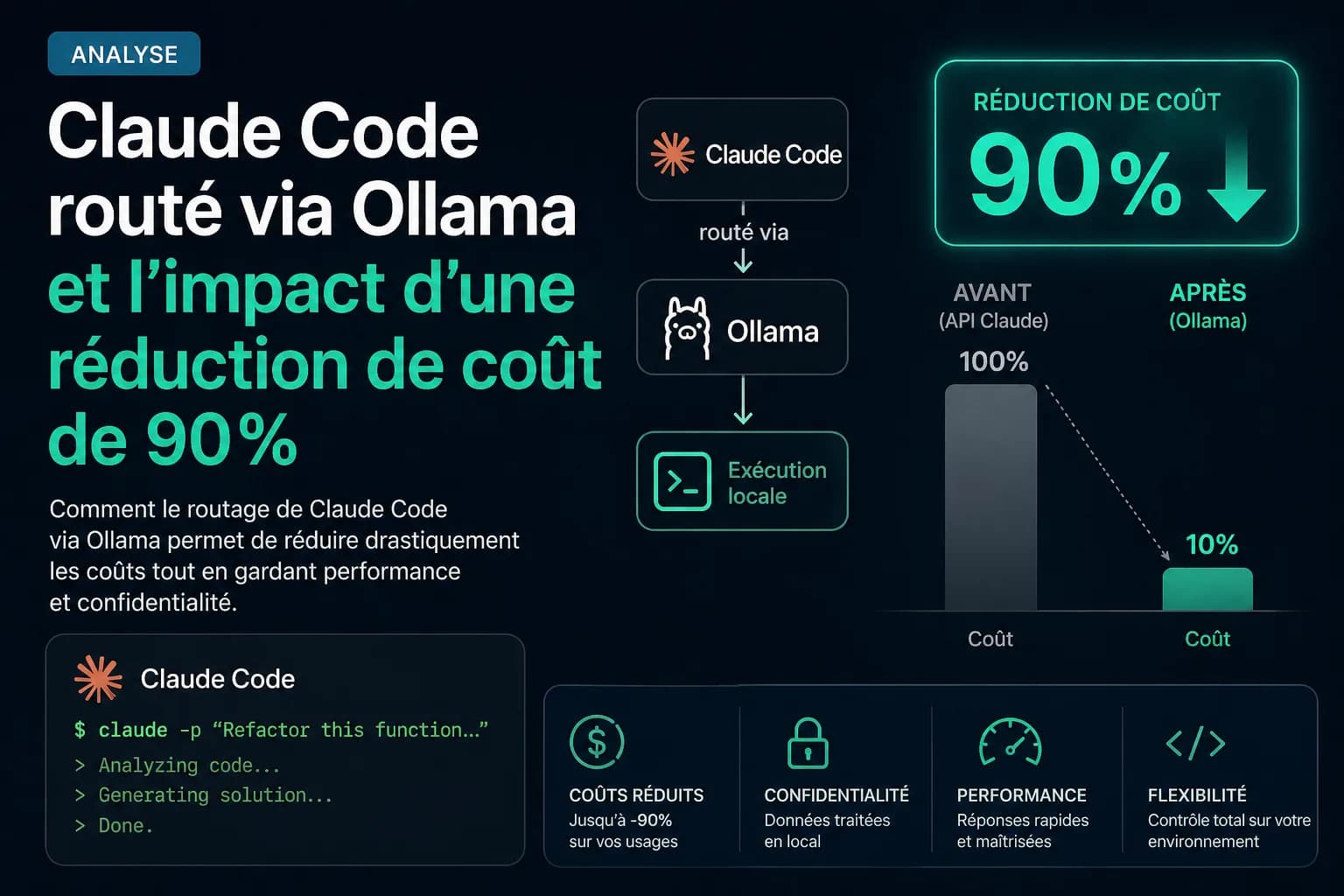
Analysis: Claude Code Routed via Ollama and the Impact of a 90% Cost Reduction
A clever integration of Claude Code through Ollama enables a cost reduction of about 90%. This financial optimization raises crucial questions about the economic models of LLM processing and their implications for users and developers.
Recent discussions on the Hacker News platform have highlighted an innovative technical strategy involving routing Claude Code via Ollama, resulting in a drastic reduction in operational costs, estimated at nearly 90%. This approach appears as a direct response to the financial challenges related to running large language models (LLMs), especially in environments where controlling expenses is critical.
This method, documented in an open-source project available on GitHub, illustrates a concrete case of AI infrastructure optimization, where software intermediation plays a key role in lowering fees associated with using costly models. This phenomenon fits into a broader context where cost management becomes a major challenge for companies and developers relying on advanced text generation models.
Within this framework, the technical community is questioning the precise mechanisms that enable such a level of savings, as well as the potential consequences for AI ecosystems, notably in terms of efficiency, latency, and result quality.
Why Is This Happening?
The main motivation behind this setup is financial: the costs associated with direct use of LLMs like Claude Code are often prohibitive, imposing significant constraints on users and developers. By integrating Ollama as an intermediary layer, it becomes possible to redistribute requests more efficiently, thus optimizing computation and reducing expenses.
This strategy also addresses the growing complexity of models and the need for better cloud resource management. AI providers generally charge based on compute volume, processed requests, or data transmitted. By reducing the direct load on Claude Code, Ollama acts as a filter or intelligent proxy, decreasing financial impact while maintaining acceptable quality.
Finally, this approach is part of a larger movement toward optimizing AI processing pipelines, where modularity and service orchestration maximize cost-performance ratios. Organizations thus seek to make the most of LLM capabilities while controlling their budgets, fostering the emergence of hybrid solutions like the one observed with Ollama.
Technically, routing Claude Code via Ollama involves using Ollama as an intermediary that receives user requests before forwarding them to Claude Code. Through this, Ollama can apply optimizations such as caching, reducing unnecessary load, or intelligently managing API calls to limit costs.
This architecture relies on a careful integration where Ollama acts as a request orchestrator, filtering and pre-processing data to avoid redundant or superfluous calls to Claude Code. This minimizes the number of requests sent to the main model, thereby reducing billable resource usage.
In the open-source context, this solution is accessible to developers wishing to experiment with and deploy more economical AI systems. It paves the way for distributed architectures where multiple components collaborate to optimize costs without sacrificing the quality of generated responses.
Numbers That Illuminate
According to data shared on Hacker News and the associated GitHub documentation, the key figure that stands out is an approximate 90% cost reduction thanks to routing Claude Code via Ollama. This percentage reflects significant efficiency in resource management.
This major saving can transform the financial equation of LLM-based projects, making their use more accessible in various contexts, from product development to research. These figures encourage deep reflection on AI service pricing structures and technical means to mitigate their impact.
Estimated cost reduction of about 90% through routing via Ollama
Optimization of API calls to limit billable load
Use of Ollama as an intermediary layer for filtering and orchestration
What Does This Change?
This radical cost optimization profoundly changes the game for French users and developers, often facing strict budget ceilings in their AI projects. It opens prospects for broader democratization of advanced technologies by making access to LLMs more affordable.
Moreover, this practice could encourage model providers to rethink their pricing offers and consider hybrid or modular solutions, integrating intermediaries to improve competitiveness and adoption of their services.
Finally, on a technical level, this architecture reflects an evolution toward more flexible and modular systems, capable of adapting to economic constraints while maintaining a high level of performance. This could influence implementation choices across various sectors, from research to commercial development.
Our Verdict
Ultimately, using Ollama to route Claude Code represents a pragmatic and innovative advance in controlling costs related to large language models. This type of technical ingenuity, documented in open source, clearly illustrates current challenges in the AI ecosystem and the tailored responses they inspire.
For the French community, often attentive to balancing performance and budget, this case study offers a concrete example of optimization to watch closely. While the long-term impact on quality and scalability remains to be confirmed, this approach opens a promising path to making AI more accessible and sustainable.