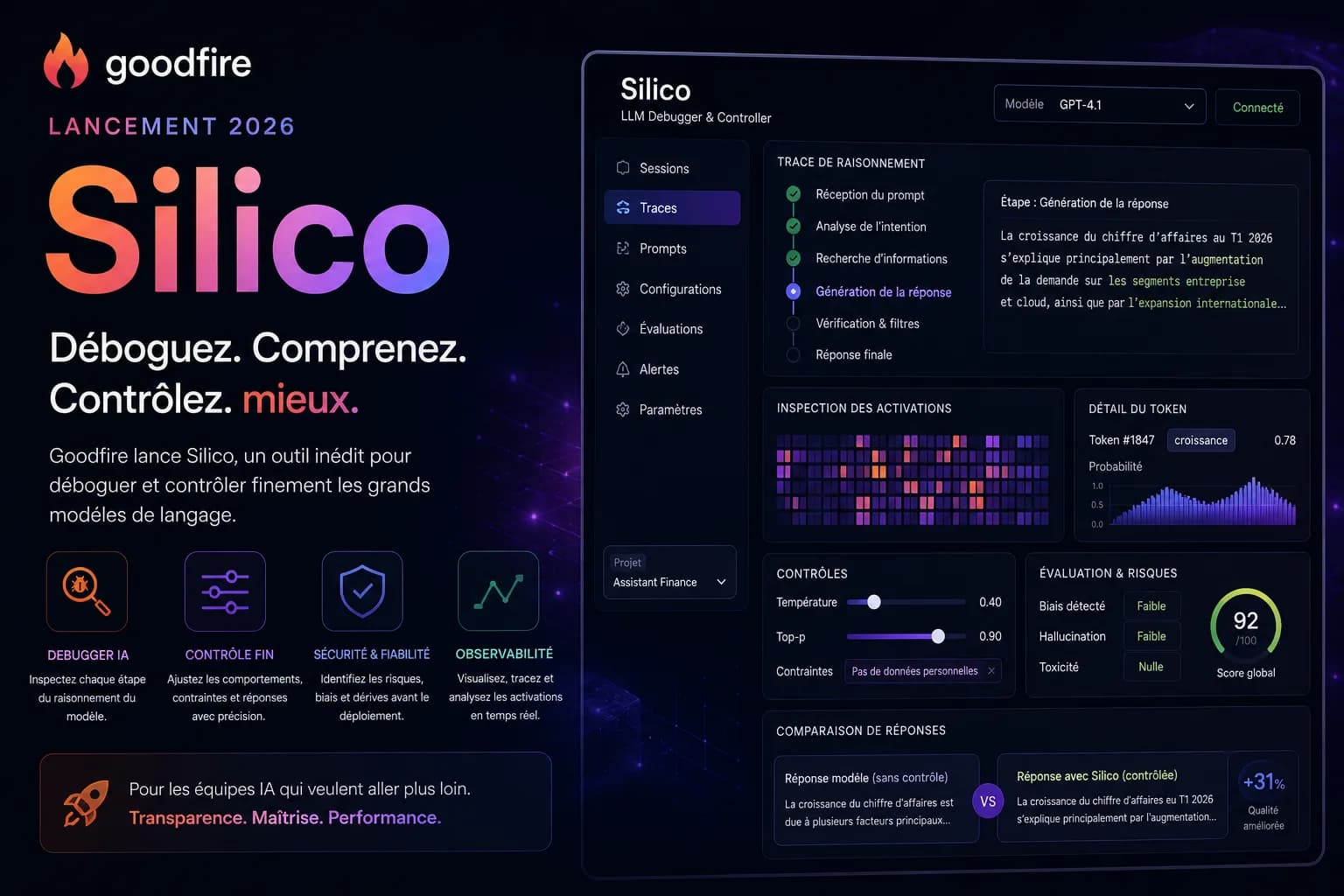
Goodfire Launches Silico, an Unprecedented Tool to Debug and Finely Control Large Language Models in 2026
The California startup Goodfire unveils Silico, an innovative tool allowing researchers to scrutinize and adjust the internal parameters of large language models (LLMs) during their training. This breakthrough promises unprecedented control over AI behavior.
A New Step Towards Transparency and Control of Large Language Models
Based in San Francisco, the young startup Goodfire has just introduced Silico, a revolutionary mechanistic interpretability tool that offers researchers and engineers the ability to directly examine the inside of an AI model. Unlike traditional approaches that treat large language models (LLMs) as black boxes, Silico allows intervention on the fundamental parameters that determine the model's behavior during its training phase.
This innovation could disrupt current AI development practices by providing a level of control previously deemed inaccessible. Goodfire claims that Silico represents a paradigm shift for the creation and customization of language models, paving the way for more reliable, modular, and safe AI.
Silico offers an interface that provides access to the internal parameters of the neural network during its training, allowing developers to modify these settings in real time. This previously unseen "debugging" capability is comparable to a software engineer correcting code during its execution, but applied to a deep learning system.
This approach significantly improves diagnostic and optimization possibilities. Users can identify erroneous or biased behaviors of the model and correct the source of the problem directly within the internal layers, rather than waiting for a complete retraining phase.
Compared to traditional tools, often limited to post-training analyses or fine-tuning adjustments, Silico introduces unprecedented responsiveness and precision. This opens significant prospects for mastering complex models, especially in sensitive contexts such as conversational assistants or decision support systems.
The Technical Innovations Behind Silico
The core of Silico is based on a software architecture enabling deep introspection of transformer neural networks, the dominant structure of LLMs. Goodfire has designed a platform capable of decomposing the model's internal functions into interpretable units, making the contribution of each parameter to the final output understandable.
The system also leverages advanced differentiable optimization techniques and mechanistic analysis algorithms to link observed behaviors to specific network components. This approach builds on recent innovations in model interpretability but pushes further by allowing dynamic modification of parameters during training.
According to Goodfire, this method circumvents the classic black-box limitations of LLMs by offering near-manual visibility and control over billions of parameters without sacrificing performance or training speed.
Accessibility and Use Cases for Researchers and Developers
Silico is available via an API aimed at research teams and machine learning engineers. This openness seeks to encourage rapid adoption of the tool in academic laboratories as well as AI-specialized companies. Goodfire offers several subscription plans tailored to varying needs in computing power and analysis volume.
Identified use cases range from rapid correction of biases in models to targeted improvement of their robustness, including experiments on ethical behavior or AI safety. This granularity of intervention could also accelerate the development of specialized models aligned with specific regulatory or industrial constraints.
A Strategic Advancement in the AI Sector
In a market where mastering LLMs is a major challenge, Silico stands out by offering much finer control than traditional interpretability tools, which are often limited to visualization or statistical analysis. This technology could redefine standards for responsible and transparent AI development.
In Europe and France, where AI regulations are tightening and ethics are central to debates, such a tool presents strategic interest. It notably responds to the growing demand for explainable and verifiable AI, a key factor for user trust and regulatory compliance.
Historical Context and Challenges of Mechanistic Interpretability
Since the popularization of large language models, the scientific community has long faced near-total opacity regarding the internal mechanisms of these systems. The concept of mechanistic interpretability, which involves understanding the concrete operations inside models, emerged as a necessary response to go beyond mere statistical analysis of behaviors. This discipline aims to reduce the complexity of millions or even billions of parameters into units comprehensible by humans, to make models more transparent and controllable.
Historically, interpretability methods focused on global approaches such as attention visualizations or feature importance, but they remained limited to post-hoc observations. Silico fits into this evolution by proposing a tool that goes further: it allows direct and dynamic interaction with the model during learning, representing a major advance in the quest to decode complex architectures.
Impact on Development Strategies and Future Perspectives
The ability to intervene in real time on internal parameters opens new tactical strategies for development teams. Rather than relying on long training and fine-tuning cycles, engineers can now quickly test and adjust specific hypotheses, correct emerging biases, or adapt the model to particular use contexts without starting from scratch. This increased flexibility could significantly accelerate time-to-market for AI applications.
In the longer term, the democratization of such tools could promote the standardization of best practices in AI ethics and safety. Regulators and certification bodies could rely on tools like Silico to audit and validate model compliance, thereby establishing a more rigorous framework for responsible development. Moreover, this level of control could encourage the creation of more specialized and adaptive models, capable of continuously adjusting as environments and data evolve.
In Summary
Silico, the new mechanistic interpretability tool developed by Goodfire, represents a significant advance in mastering large language models. By offering unprecedented visibility and control over internal parameters during training, it paves the way for more transparent, reliable, and adaptable AI. This innovation comes at a crucial moment when ethical and regulatory demands push for better understanding and management of artificial intelligence systems. Despite upcoming technical and organizational challenges, Silico could well become an essential standard for responsible AI development of tomorrow.