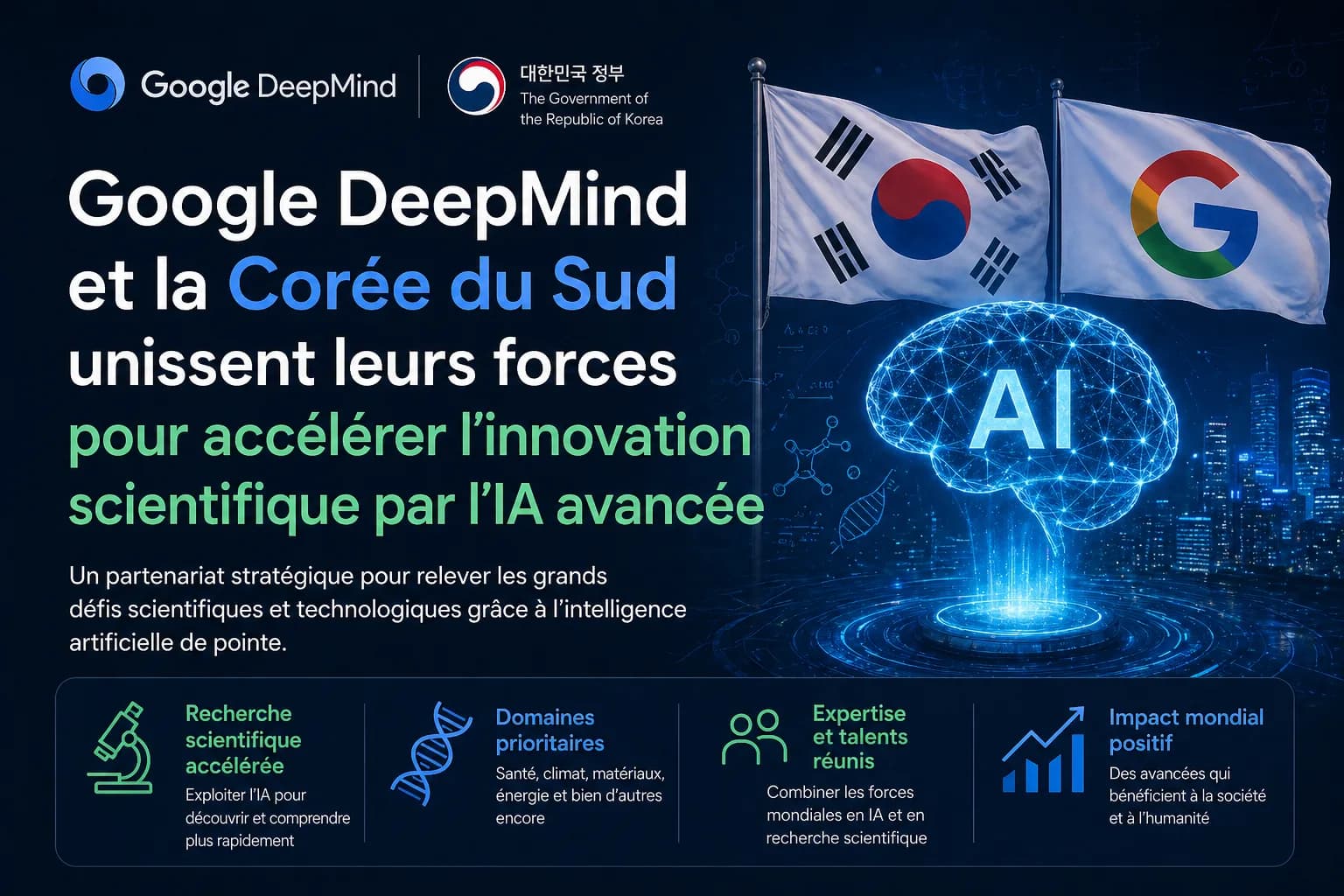
Google DeepMind and South Korea Join Forces to Accelerate Scientific Innovation through Advanced AI
Google DeepMind announces a strategic partnership with the Republic of Korea to deploy cutting-edge artificial intelligence models in support of scientific breakthroughs. This major collaboration highlights the growing influence of AI in global research.
An Unprecedented Partnership to Accelerate Scientific Research with AI
Google DeepMind has just formalized a strategic collaboration with the Republic of Korea aimed at leveraging the capabilities of next-generation artificial intelligence models to boost scientific discoveries. This partnership fits within a global trend where AI technologies play an increasingly important role in solving complex problems, notably in biomedical, environmental, and materials science fields.
Through this alliance, DeepMind provides its expertise in advanced AI, while South Korea contributes its innovative ecosystem and advanced research infrastructures. This synergy aims to accelerate innovation cycles by combining algorithmic expertise and big data, reflecting the strategic importance given to AI in national scientific development plans.
Concrete Applications: Rapid and Targeted Advances
Specifically, this partnership is expected to enable the deployment of DeepMind models capable of analyzing and interpreting scientific data at unprecedented scale and speed. For example, in pharmaceutical research, AI can more quickly identify candidate molecules or simulate complex interactions, thereby significantly reducing development timelines.
Beyond health, other scientific sectors will benefit from this collaboration, notably materials physics and climatology, where AI-driven modeling and predictions have become indispensable tools. The ability to process massive volumes of data and extract complex patterns promises breakthroughs that would have been out of reach with traditional methods.
Compared to similar initiatives in Europe or the United States, this collaboration demonstrates a clear intent to integrate DeepMind models within an ambitious public-private innovation framework, with a medium-term expected impact on scientific and economic competitiveness.
Under the Hood: Architectures and Technological Innovations
DeepMind relies on advanced deep neural network architectures, combining supervised learning, reinforcement learning, and self-supervision techniques. These models leverage massive computing power and optimized algorithms to process multimodal and heterogeneous data typical of scientific challenges.
A key innovation lies in the models’ ability to integrate prior knowledge, enabling better generalization and increased interpretability of results—two crucial aspects for research. The partnership with South Korea will also explore hybrid approaches combining symbolic AI and deep learning to address complex scientific problems.
Training these models relies on colossal datasets from Korean laboratories and international databases, combined with DeepMind’s expertise in algorithmic optimization. This technical alliance promises a qualitative leap in AI’s capacity to generate hypotheses and propose innovative solutions.
Access and Deployment: Towards Democratizing Scientific AI
The partnership plans progressive access to the developed AI tools, in the form of secure APIs and collaborative platforms, facilitating integration into Korean researchers’ workflows. This approach aims to democratize the use of DeepMind models by reducing the technical and financial barriers often associated with advanced technologies.
Information regarding opening access to French partners or researchers is not confirmed at this stage, but this initiative could serve as a model for other international collaborations. The rigorous Korean regulatory and ethical framework will be a key element to ensure responsible use of AI technologies in research.
Impact on the AI Ecosystem and Global Research
This alliance between DeepMind and South Korea illustrates the rising power of transnational collaborations integrating AI as a lever for scientific innovation. In Europe, where advanced AI initiatives still struggle to establish themselves on a large scale, this partnership highlights the importance of strong and structured commitment around AI technologies to remain competitive.
On the geopolitical level, South Korea’s investment in scientific AI through this channel demonstrates a determined strategy to strengthen its technological leadership, facing American and Chinese giants. For the scientific community, it opens the way to shared infrastructures and accelerated research cycles, with potential impacts on health, environment, and industry.
A Major Advance with Prospects and Limitations
While this partnership marks a significant step in integrating advanced AI into scientific research, several challenges remain. The complexity of the models and the need for multidisciplinary expertise to exploit them remain obstacles to immediate widespread adoption. Moreover, the issue of transparency and interpretability of generated results remains central for rigorous scientific validation.
However, the joint commitment of DeepMind and the Republic of Korea offers a promising dynamic. Monitoring this collaboration will be crucial to observe how AI models can truly transform research methods while respecting the ethical and social issues related to these technologies.
Historical and Strategic Context of the Partnership
This partnership fits within a recent history where South Korea has progressively strengthened its AI capabilities, integrating this technology as a pillar of its national innovation strategy. Historically, the country has invested heavily in digital infrastructures and specialized talent training, creating fertile ground to host high-level international collaborations. On its side, DeepMind, which has marked major AI advances in recent years, seeks to extend its scientific impact by partnering with entities able to provide diverse data and contexts.
This historical context reminds us that scientific and technological research is increasingly characterized by global alliances combining resources, expertise, and strategic ambitions. South Korea and DeepMind thus engage in a dynamic that goes beyond simple technological collaboration to become a lever of economic and political power on a global scale.
Tactical Issues and Positioning within the Global Scientific Ecosystem
From a tactical perspective, this partnership aims to leverage complementary strengths: DeepMind brings its algorithmic expertise and advanced architectures, while Korea offers a dynamic environment and high-quality data from its research infrastructures. This cooperation will explore areas still little exploited by AI, notably fundamental sciences where current models face limits in interpretability and complexity.
Furthermore, this alliance aims to position Korea as a central AI research hub in Asia, thus competing with American and Chinese centers. Integrating DeepMind models into Korean laboratories should also provide a competitive advantage to local companies, notably in pharmaceutical, energy, and environmental sectors, by accelerating the development of innovative solutions.
Prospects for Evolution and Impact on Global Scientific Rankings
In the medium term, the collaboration should strengthen South Korea’s position in global scientific research rankings, often dominated by the United States and China. Access to cutting-edge AI models will increase the production of high-quality results, speed of discoveries, and integration of AI in multidisciplinary projects.
This advance could also encourage other countries to follow this public-private partnership model, combining national resources and imported cutting-edge technologies to remain competitive in the global innovation race. Finally, the success of this collaboration could lead to international standards and best practices for the responsible use of AI in scientific research, a crucial issue amid evolving regulation.
In Summary
The partnership between Google DeepMind and the Republic of Korea represents a major milestone in integrating advanced artificial intelligence technologies into scientific research. By combining DeepMind’s technological strengths and Korea’s innovative ecosystem, this alliance promises to accelerate discoveries in key fields such as health, environment, and materials physics. Despite challenges related to model complexity and the need for multidisciplinary expertise, this collaboration opens the way to a new era of international scientific innovation, with potentially significant impacts on economic competitiveness and technological sovereignty. Careful monitoring of this initiative will be essential to measure its real influence on research practices and the ethical frameworks surrounding AI use.