Humanoid and Schaeffler Deploy Thousands of Humanoid Robots in Manufacturing Industry
Humanoid and Schaeffler launch one of the largest deployments of humanoid robots in factories, aiming to transform industrial production. This collaboration opens a new era of advanced automation.
A Massive Deployment of Humanoid Robots in Factories
Humanoid and Schaeffler have just announced a major strategic partnership to introduce thousands of humanoid robots into industrial production lines. According to AI Business, this is one of the largest deployments ever carried out to date, marking a significant turning point in factory automation.
This ambitious deployment aims to integrate these robots into assembly lines and repetitive operations, with the goal of improving productivity while reducing labor-related costs. This technological choice fits into a growing trend of adopting humanoid robots capable of interacting with complex and varied environments, in an industrial sector undergoing a digital transformation.
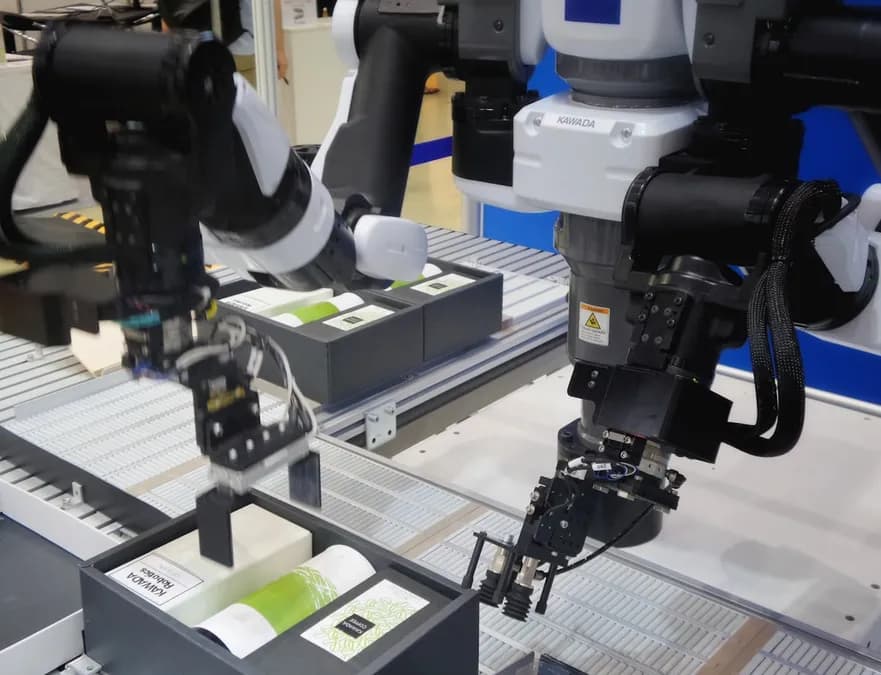
These humanoid robots are designed to perform a wide range of tasks, from handling delicate objects to executing precise industrial processes requiring great dexterity. Their design allows smooth adaptation to different workstations, facilitating their integration into existing production lines without requiring major modifications.
Compared to traditional industrial robots, often limited to repetitive movements in confined environments, these humanoids offer increased flexibility thanks to their mobility and decision-making capabilities. This evolution notably allows managing non-standard situations or real-time adjustments, thus reducing interruptions and errors.
Initial demonstrations have shown significant potential to accelerate production cycles while maintaining a high level of quality, a key issue for Schaeffler, a global leader in supplying mechanical and electronic components for the automotive industry and other sectors.
Underlying Architecture and Technical Innovations
The operation of these robots relies on a combination of advanced artificial intelligence and sophisticated mechatronic technologies. Their architecture integrates multidimensional sensors, computer vision systems, and machine learning algorithms capable of interpreting the environment in real time.
The robots are trained via AI models specifically developed to understand and reproduce complex human gestures, while ensuring the safety of human operators present on industrial sites. This synergy between hardware and software optimizes each task while ensuring harmonious interaction between humans and machines.
This technical innovation goes beyond the usual frameworks of collaborative robots (cobots) by offering true operational autonomy, heralding a new generation of robotic solutions for the industry of the future.
Accessibility and Operational Deployment
The partnership plans a gradual deployment of robots in several Schaeffler factories worldwide, prioritizing sites with high manual labor intensity. Access to these robots will be extended to production teams via intuitive interfaces, facilitating their programming and supervision without requiring advanced technical skills.
Regarding commercialization, exact terms remain to be confirmed, but it is planned that this offer will mainly target large industrial companies seeking to modernize their production. Integration may be accompanied by maintenance and continuous optimization services to ensure a rapid return on investment.
Impact on the Industrial Sector and Competition
This massive deployment positions Schaeffler and Humanoid as pioneers in the large-scale adoption of humanoid robots in industrial environments, an advancement that could redefine industry standards. Until now, industrial robotics was dominated by specialized and rigid machines, while this new generation promises more versatility and efficiency.
From a competitive standpoint, this initiative could encourage other players to accelerate their own intelligent automation programs, especially in Europe where workforce aging and competitiveness challenges push for rapid innovation. This movement helps strengthen technological sovereignty in advanced robotics, a strategic issue for the local industry.
Critical Analysis and Perspectives
While the announcement of this deployment marks a major milestone, questions remain about the long-term adaptation of these robots to the diversity of industrial environments and their ability to integrate seamlessly with existing processes. Moreover, employee acceptance and management of social impacts remain important challenges to anticipate.
However, this collaboration between Humanoid and Schaeffler clearly illustrates the rise of intelligent robotic technologies in the manufacturing sector. It paves the way for more flexible and human-centered automation, likely to sustainably transform production methods and industrial competitiveness.
Historical Context of Robotic Integration at Schaeffler
For several decades, Schaeffler has been at the forefront of industrial innovation, progressively integrating robotic solutions into its production processes. Historically, the company initially relied on traditional industrial robots to automate repetitive and standardized tasks. However, with increasing demands for flexibility and product customization, this approach showed its limits.
This partnership with Humanoid represents a major evolution in Schaeffler's automation strategy, symbolizing its commitment to adopting cutting-edge technologies to remain competitive in a rapidly changing global market. The company thus capitalizes on its experience while clearly positioning itself in the race toward Industry 4.0.
Tactical Challenges Related to the Integration of Humanoid Robots
The massive introduction of humanoid robots raises significant tactical challenges, notably in terms of organizing production lines and managing workflows. These robots, thanks to their flexibility and adaptability, allow rethinking industrial processes to gain efficiency and responsiveness in the face of demand variations.
Moreover, operator training and the establishment of new human-machine collaboration routines are key elements to ensure a successful transition. Teams must learn to supervise and interact with these robots, which implies an evolution of skills and professional practices on the ground.
Evolution Perspectives and Long-Term Impact
In the medium and long term, this deployment could profoundly transform industrial organization by paving the way for more agile and customized production. The ability of humanoid robots to quickly adapt to different contexts could foster innovation in new product development and diversification of industrial offerings.
Furthermore, this technological advancement could influence the competitive landscape by positioning pioneering companies as leaders in the global market. Nevertheless, the success of this transformation will largely depend on the ability of industrial players to manage the human and social aspects associated with intelligent automation.
In Summary
The partnership between Humanoid and Schaeffler marks a decisive step in the evolution of industrial robotics, with the large-scale deployment of humanoid robots in factories. This initiative illustrates the desire to integrate advanced technological solutions to improve productivity, flexibility, and quality of industrial processes. Despite challenges related to adoption and social acceptance, this project opens promising prospects for the industry of the future, combining innovation, competitiveness, and human transformation.