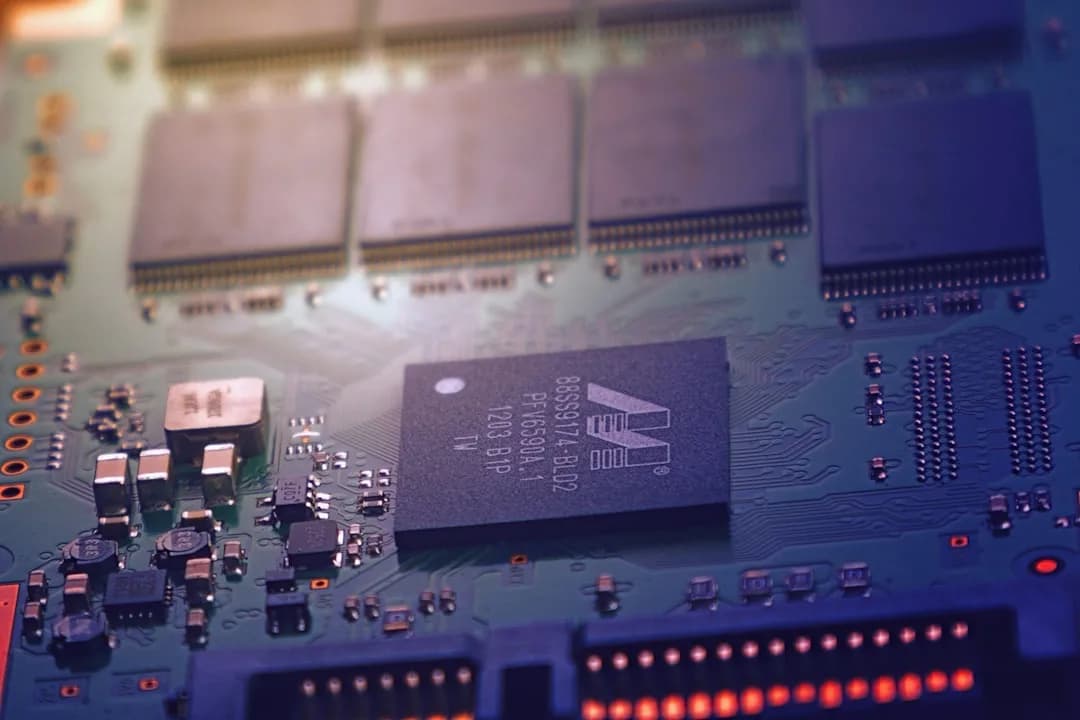
Facing the announced end of Moore's Law, industry players are integrating AI into semiconductor design. Samsung exemplifies this trend by embedding AI directly into its memory chips to accelerate processing.
As transistor miniaturization reaches its physical limits, microelectronics players are adopting artificial intelligence (AI) to transform chip design. This approach aims to overcome the constraints imposed by the imminent end of Moore's Law.
Samsung has notably taken a major step by integrating AI capabilities directly into its memory chips, enabling processing-in-memory, an innovation that promises to significantly improve performance.
Moore's Law, which predicted a regular doubling of the number of transistors on a chip, now shows its technical and economic limits. Engineers can no longer simply shrink transistor sizes to increase processor power.
In this context, AI is used to automate and optimize integrated circuit design. According to available information, Samsung applies this technology notably to design chips capable of executing processing directly within memory, thus reducing latency times and energy consumption.
This innovative approach marks a break with traditional methods that focused on transistor densification and refinement of classical architectures.
Why It Matters
The integration of AI into chip design represents an essential strategic response to the stagnation of miniaturization. It paves the way for new architectures capable of improving computing power without relying solely on physical advances in semiconductors.
In particular, processing-in-memory overcomes the bottleneck related to exchanges between memory and processor, a major limiting factor in current systems. This technology thus promises crucial gains in performance and energy efficiency for artificial intelligence, high-performance computing, and big data applications.
Industry Reaction
This development is hailed as a key milestone by microelectronics and AI specialists. It illustrates a global trend to embed intelligent capabilities directly into hardware components, a direction expected to disrupt computer system design.
European and French players, facing a deficit in advanced chip production capacity, are watching these American and Asian developments with interest, aware of the urgency to close their innovation gap to remain competitive.
Next Steps
The next stages will involve extending the use of AI in semiconductor design to other types of chips, refining optimization algorithms, and developing suitable industrial processes. At the same time, the commercial deployment of chips integrating processing-in-memory is expected to accelerate in the coming years, confirming this new era of electronic design.
Historical Context and Technological Evolution
Since the birth of microelectronics in the 1950s, the race to miniaturize transistors has dominated the trajectory of the semiconductor industry. Moore's Law, formulated in 1965, served as a roadmap by predicting a doubling of the number of transistors on a chip every two years, fueling decades of innovation and exponential growth in computing power.
However, as transistors approach atomic-scale dimensions, physical, thermal, and economic challenges limit this progression. The increasing complexity of circuits and the exorbitant cost of manufacturing equipment push companies to explore alternatives. It is in this context that artificial intelligence emerges as a promising solution, not only to design but also to fundamentally rethink chip architectures.
By integrating AI into the design process, manufacturers can automate complex tasks such as transistor layout or signal path optimization, thereby reducing human errors and accelerating development. This revolution opens the way to a new era where algorithmic creativity complements human ingenuity.
Tactical Stakes and Industry Impact
The integration of AI into chip design is not limited to simple time or cost savings. It enables unprecedented strategies, such as processing-in-memory, which radically changes how data is handled within electronic systems. This paradigm drastically reduces dependence on frequent exchanges between memory and processor, a major source of latency and high energy consumption.
From a tactical standpoint, this means chips can now handle massive and complex workloads typical of AI and high-performance computing applications with increased efficiency. Companies mastering these technologies will be able to offer more competitive products, thus accelerating their positioning in an extremely competitive global market.
This dynamic also drives a reevaluation of supply chains and industrial investments, notably in Europe and France, which seek to strengthen their autonomy in a sector strategic for the digital economy. AI applied to chip design thus becomes a key lever to support technological sovereignty.
Future Perspectives and Challenges
While the initial results of integrating AI into chip design are promising, several challenges remain to generalize these innovations. Among them are the development of even more efficient optimization algorithms and the creation of industrial processes capable of producing these complex architectures at large scale.
Moreover, collaboration between AI specialists, microelectronics engineers, and manufacturers must be strengthened to ensure harmonious integration of new technologies. Training hybrid talents capable of navigating these disciplines also emerges as a priority.
Finally, the rise of processing-in-memory could pave the way for entirely new architectures, challenging current standards. This technological revolution could transform not only chip design but also their role in computer systems, opening unprecedented prospects for artificial intelligence and industrial applications.
In Summary
The announced end of Moore's Law is pushing the semiconductor industry to rethink its design methods. The integration of AI into chip design, notably through processing-in-memory, represents a major advance to overcome the physical and economic limits of miniaturization.
This transition marks a strategic turning point, offering unprecedented possibilities in terms of performance and energy efficiency while posing new technological and industrial challenges. In a tense global context, this evolution is also crucial to preserve the competitiveness and sovereignty of European and French actors in the face of American and Asian giants.
The coming years will be decisive to confirm this trend and sustainably transform the microelectronics landscape thanks to artificial intelligence.