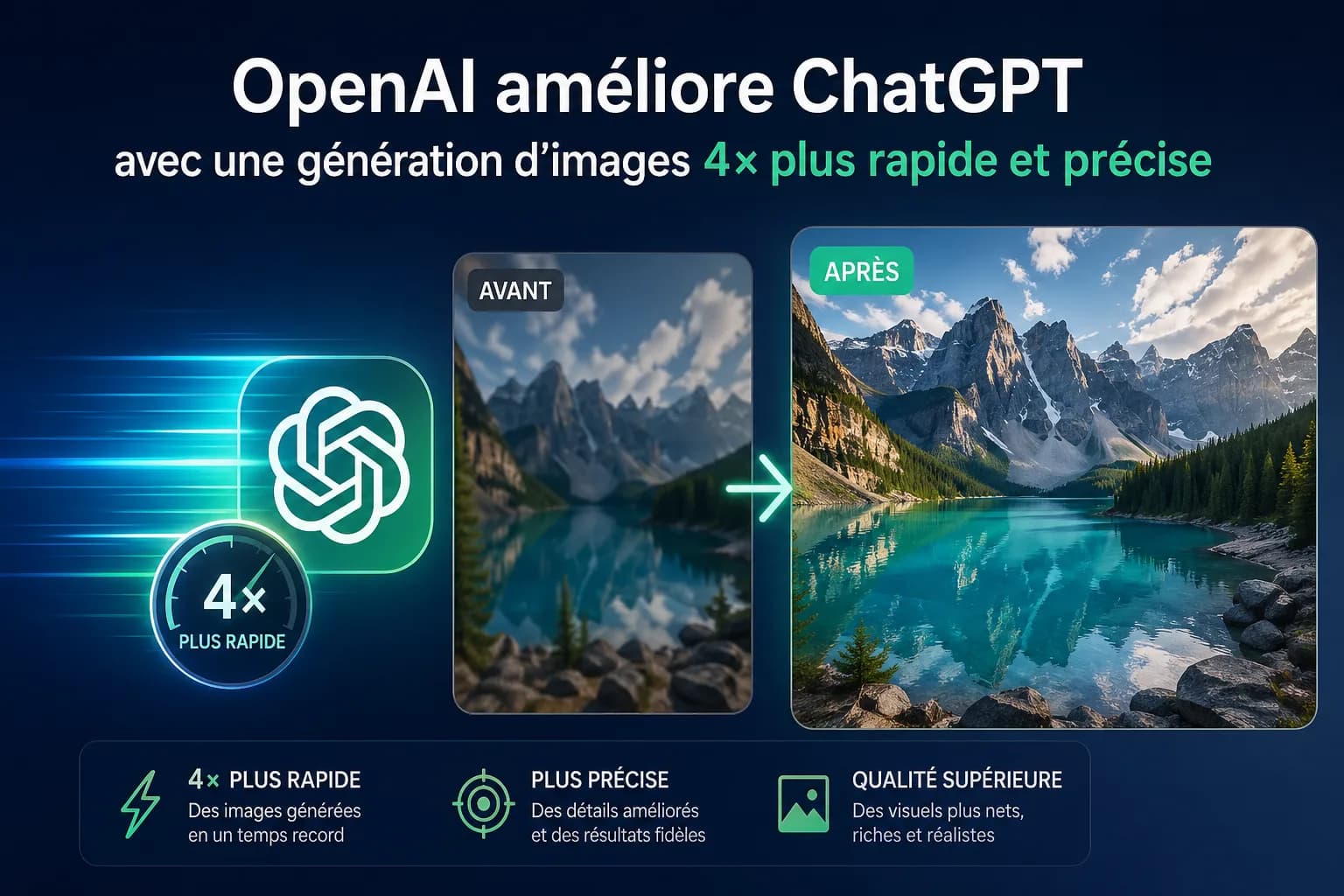
OpenAI Enhances ChatGPT with Image Generation 4× Faster and More Accurate
OpenAI is rolling out a new version of ChatGPT Images featuring its flagship model GPT-Image-1.5, offering more precise edits and consistent details. This update, available to all users and via API, speeds up visual creation by up to four times.
A Major Breakthrough in AI Image Generation at OpenAI
OpenAI has just launched a significant update to its image generation tool integrated into ChatGPT. This new version, powered by the GPT-Image-1.5 model, promises a notable improvement in both speed and quality of generated images. The rollout is effective today for all ChatGPT users, as well as through the dedicated API, thus opening new opportunities for French-speaking developers and creators.
This evolution places OpenAI at the forefront of the sector by enhancing its model's ability to produce visuals with coherent details and more precise edits, while accelerating the process up to four times compared to previous versions.
Concrete Performance for Creative and Professional Uses
Specifically, users benefit from smoother image generation and improved fidelity of visual elements. The GPT-Image-1.5 model enhances the consistency of textures, colors, and shapes, eliminating much of the typical inconsistencies encountered in earlier generations. These advances are particularly noticeable during targeted modifications on existing images, where edits are now more natural and precise.
This technical boost also enables a significant acceleration, drastically reducing wait times to obtain one or a series of images. For professionals, this means increased productivity, notably in design, advertising, and visual prototype development sectors.
Compared to the previously deployed version, this new model marks a turning point in ChatGPT’s ability to integrate high-quality multimodal functions, reinforcing the platform’s versatility.
Under the Hood: Technical Innovations and Model Architecture
The GPT-Image-1.5 model is based on a refined architecture that combines advanced deep learning and image processing techniques. This version notably improves the handling of fine details and spatial coherence through a better contextual understanding of generated or modified images.
The training relied on extensive and diverse datasets, enabling the model to learn to generate nuanced images faithful to complex textual descriptions. This approach ensures better stability in outputs, which was a weak point in previous iterations.
This technical sophistication also translates into optimized computing resources, making faster generation possible without sacrificing quality.
Accessibility and Integration: Large-Scale Deployment
The update is immediately accessible to all ChatGPT users without requiring a specific subscription, democratizing the use of this advanced technology. Furthermore, the GPT-Image-1.5 API is available for developers wishing to integrate these capabilities into their own applications, paving the way for numerous innovative use cases.
This increased accessibility supports varied applications, ranging from personalized illustration generation to rapid marketing content creation and visual assistance in complex creative processes.
A Paradigm Shift in the AI Image Generation Ecosystem
This announcement confirms OpenAI’s commitment to consolidating its technological lead in the AI image generation market. By ensuring better quality and increased speed, OpenAI sets a high bar against international competition, notably in Asia and the United States, where several players are heavily investing in this segment.
For the French and European markets, this evolution represents a major opportunity to integrate high-performance solutions without compromise, facilitating AI adoption in strategic sectors such as digital creation, cultural industries, and advertising.
Outlook for French-Speaking Creators and Businesses
With this new version, French-speaking creators now have a powerful tool to enrich their visual projects without the usual technical constraints. The increased speed opens the door to more dynamic experimentation, allowing, for example, the testing of multiple graphic concepts in a reduced timeframe.
For companies, especially in communication and advertising sectors, integrating GPT-Image-1.5 via the API represents a real lever to automate the creation of personalized visual content at scale. This could transform traditional workflows by reducing production times while increasing deliverable quality.
Moreover, the ability to generate images with better coherence opens prospects in areas such as e-commerce, where visual product presentation is crucial, as well as in training and technical documentation, where precise illustrations enhance understanding.
Ethical Issues and Regulatory Challenges Related to AI Image Generation
As the power of image generation models continues to grow, ethical questions about their use become more pressing. OpenAI, aware of these issues, encourages responsible deployment by providing built-in safeguards and collaborating with the community to define ethical standards.
In Europe, where regulation is often stricter, transparency about the data used for training and the ability to control generated content are crucial points. Users must be vigilant regarding copyright and the potential use of images in sensitive contexts.
Finally, the risk of spreading manipulated or misleading content through artificially generated images requires increased vigilance. Thus, OpenAI and authorities may work together to develop detection tools and appropriate legal frameworks, ensuring compliant and ethical use of these technologies.
Our Perspective: A Promising Advance, but with High Expectations
While this update marks an important milestone, it remains to be seen how well the model adapts to very specific contexts and maintains this quality over time. Professional uses demand consistency and mastery of details, which will be the next challenges to address.
Furthermore, the democratization of these tools raises questions about ethics and content regulation, a crucial aspect for French and European stakeholders who are attentive to these issues.
In conclusion, GPT-Image-1.5 offers a new technological benchmark in the landscape of AI image generation, with a strong promise of impact on creative and industrial uses.