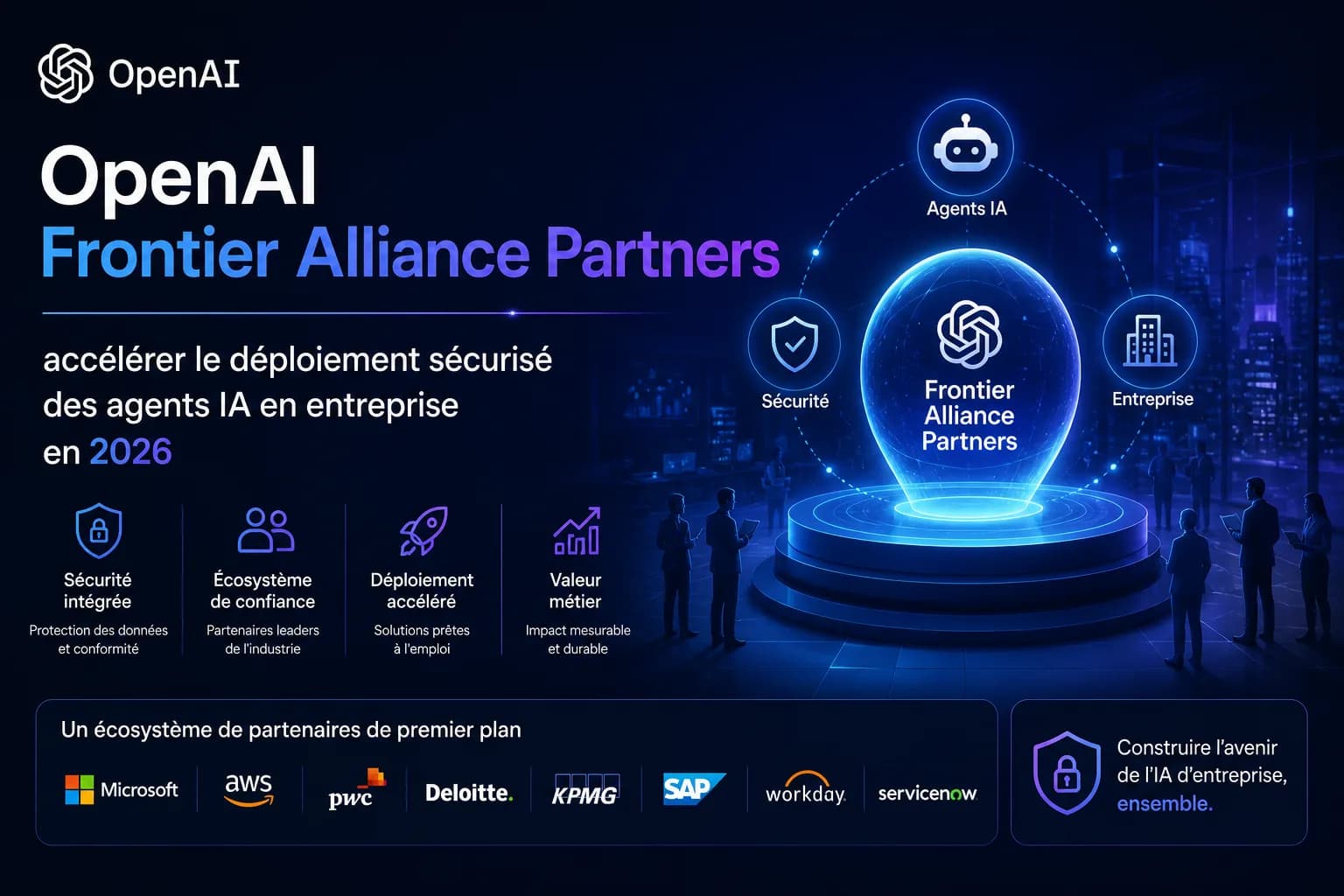
OpenAI launches Frontier Alliance Partners, a program to support companies in moving from AI prototypes to large-scale production through secure and scalable agent deployments. A major breakthrough for industrial AI integration.
OpenAI Launches Frontier Alliance Partners to Industrialize Enterprise AI
OpenAI announces the creation of Frontier Alliance Partners, an initiative designed to facilitate companies' transition from pilot phases to secure, large-scale operational deployment of their artificial intelligence agents. This program primarily targets industrial players wishing to leverage OpenAI's advanced model capabilities while managing challenges related to security, scalability, and governance.
Scaling AI projects into production remains a significant challenge: technical complexity, security risks, and integration constraints often slow adoption. Frontier Alliance Partners aims to provide dedicated expertise and support to deploy AI agents that meet the requirements of critical and regulated environments.
Secure and Scalable AI Agents for Concrete Use Cases
Specifically, the program helps companies implement agents capable of autonomously interacting with their business systems while adhering to high standards of confidentiality and robustness. These agents can perform tasks such as process automation, decision support, or managing complex workflows, adapting to volume and operational demands.
Compared to simple prototypes or pilots, these production deployments offer increased reliability and seamless integration into existing infrastructures. OpenAI also provides tools to monitor the performance and security of these agents in real time, ensuring continuous governance.
This offering responds to the growing needs of large French and European companies seeking to move beyond AI experimentation and integrate these technologies into their value chains while ensuring compliance and traceability.
Under the Hood: An Architecture Designed for Security and Flexibility
Frontier Alliance Partners is based on a modular architecture allowing enhanced control of interactions between AI agents and information systems. This structure ensures sensitive data is processed in secure environments, with integrated encryption and auditing mechanisms.
The infrastructure supports both on-premise and cloud deployments, offering essential flexibility for regulated sectors. The program relies on OpenAI's advanced models, optimized for specific enterprise uses, while incorporating layers of human and automated supervision to prevent non-compliant behavior.
Accessibility and Integration Modalities for Companies
Interested companies can join Frontier Alliance Partners through a registration process available on OpenAI's official website. The program offers personalized integration services, dedicated training, and ongoing support to assist IT and business teams.
Regarding pricing, OpenAI announces a formula adapted to large-scale deployments, with an economic model based on usage and the complexity of deployed agents. Access to APIs and monitoring tools is included, thus facilitating operational management.
A Key Step for the Maturity of the Enterprise AI Market
This initiative arrives at a time when French and European companies are accelerating their AI projects but still face major obstacles moving from proof of concept to industrialization. By offering a secure and scalable framework for AI agents, OpenAI strengthens its position against players like Google Cloud and Microsoft Azure, which also provide AI integration solutions.
Frontier Alliance Partners could thus become an important lever to democratize AI usage in companies, especially in sensitive sectors such as finance, energy, or healthcare, where compliance and security are top priorities.
Analysis: A Step Toward Reliability and Widespread AI Adoption in Production
The launch of Frontier Alliance Partners highlights OpenAI's commitment to addressing companies' concrete needs beyond technological demonstrations. By offering comprehensive support, OpenAI facilitates the upskilling and trust necessary to deploy AI agents at scale.
Challenges remain significant, particularly regarding risk management related to agent autonomy and protection of sensitive data. The success of this initiative will depend on OpenAI's ability to maintain a balance between performance, security, and compliance—key factors to convince French and European companies to take the leap.
February 23, 2026, thus marks a significant advance in the AI ecosystem, providing a concrete response to production challenges that still hinder widespread adoption of intelligent agents today.
Historical Context and Evolution of AI Industrialization in Enterprises
Since the emergence of the first artificial intelligence models, companies have gone through several phases, from experimentation to large-scale implementation. Initially, AI projects remained confined to research labs or limited demonstrations. With the advent of large computing capabilities and powerful language models, a new need emerged: how to move from proof of concept to robust deployments in critical business environments?
OpenAI, a pioneer in developing advanced technologies, quickly identified these challenges and proposed scalable solutions. The Frontier Alliance Partners initiative fits into this dynamic, aiming to bridge the gap between technological innovation and industrial integration. It also responds to growing expectations from regulators and end customers, who demand transparency, security, and performance in AI usage.
This evolution takes place in a global context where AI becomes a strategic lever for competitiveness, digital transformation, and value creation, especially in sectors where risk management is crucial.
Tactical and Strategic Challenges of Large-Scale AI Deployments
Deploying AI agents at scale involves overcoming several tactical challenges, notably managing risks related to data security, regulatory compliance, and integration with existing systems. Frontier Alliance Partners offers an architecture that incorporates advanced monitoring and auditing mechanisms, essential to detect and prevent anomalies or non-compliant uses.
Strategically, this initiative enables companies to better control their AI investments by avoiding risks associated with rushed or insufficiently secured deployments. Moreover, it facilitates a progressive upskilling of internal teams through training and personalized support. This approach strengthens stakeholder confidence, a sine qua non condition to generalize AI usage in sensitive sectors.
Facing increased competition in the AI solutions market, OpenAI's program offers a differentiating advantage by combining technological power with a rigorous framework, thus contributing to accelerating companies' digital transformation.
Future Perspectives and Potential Impact on the European Market
By promoting secure and scalable deployment of AI agents, Frontier Alliance Partners could profoundly transform how European companies adopt artificial intelligence. This initiative comes at a pivotal moment when technological sovereignty and data protection are central concerns.
By supporting organizations in implementing solutions compliant with local requirements, OpenAI helps strengthen companies' competitiveness while respecting strict regulatory frameworks. This program could also stimulate the emergence of local AI ecosystems, fostering innovation and the creation of skilled jobs.
Finally, by facilitating the transition to mature industrial uses, Frontier Alliance Partners contributes to democratizing AI, making it accessible not only to large multinationals but also to ambitious SMEs, thus paving the way for broader and responsible adoption of these technologies.
In Summary
OpenAI's Frontier Alliance Partners represents a major advance for AI industrialization in enterprises. By offering a secure, flexible, and supported framework, this program addresses the technical, regulatory, and organizational challenges companies face in their transition to large-scale AI deployments. It fits within a historical dynamic of AI evolution toward robust industrial uses and opens new perspectives for the European market. The next step will be to observe how this initiative is adopted and integrated into the digital transformation strategies of economic players.