Spotify Launches a “Verified by Spotify” Badge to Authenticate Real Artists Amid the Rise of AI in 2026
Spotify introduces a verification badge designed to ensure that artist profiles are genuinely managed by real musicians, in a context of increasing fake profiles and AI-generated creations. This initiative marks a key step in the fight against fraudulent content on music platforms.
Spotify Rolls Out a Verification Badge to Certify Authentic Artists
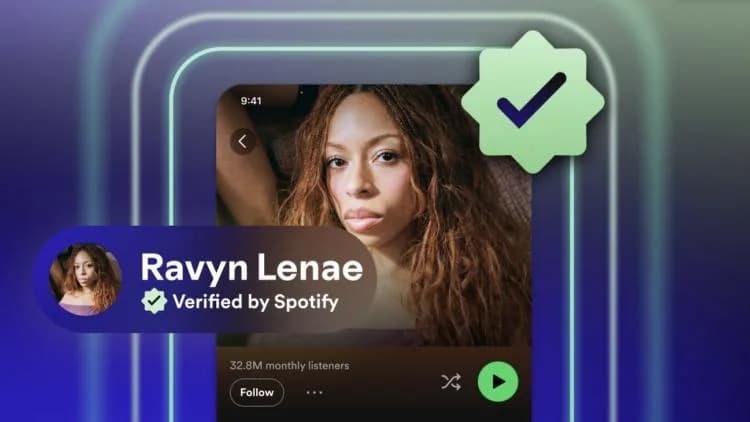
In April 2026, Spotify announced a new initiative aimed at combating the proliferation of fraudulent content, notably artist profiles generated or manipulated by artificial intelligence. The music streaming platform is introducing a “Verified by Spotify” badge displayed on artist profiles whose identity has been confirmed by the company. Accompanied by a green checkmark visible on the profile page, this label assures listeners that the music truly comes from a real human creator.
This verification program comes amid growing concerns over the multiplication of fake profiles, often automated or powered by artificial intelligences, which worry music industry stakeholders and users alike. Spotify thus intends to strengthen listener trust in the artists they listen to and protect the integrity of its catalog.
The “Verified by Spotify” badge acts as a mark of authenticity, allowing users to easily distinguish human artists from automated or fictitious entities. At launch, Spotify specifies that some profiles created entirely or partially by AI, which the platform calls “AI personas,” will not be eligible for this certification.
The system adds a layer of transparency in an ecosystem where AI-generated creations are multiplying, sometimes without clear indication. For users, this label translates into greater assurance that the musical content is indeed produced by a genuine artist, which is especially crucial for discovery and algorithmic recommendations.
Compared to previous verification attempts, often based on limited criteria or sporadic manual validation, this program relies on a more rigorous process officially recognized by Spotify. It continues the platforms’ efforts to preserve the quality and legitimacy of distributed content.
Architecture and Technical Mechanisms Behind the Verification
Spotify has not fully detailed the exact workings of the program, but it likely relies on a combination of manual and automated checks. The goal is to reliably identify real creators through profile validation, identity verification, and confirmation of musical production.
This approach probably also includes metadata analysis, detection of anomalies related to suspicious or automated behavior, and the use of artistic identity databases. The major innovation lies in the ability to effectively distinguish human entities from “AI personas,” a growing challenge in the entertainment industry.
In parallel, Spotify continues efforts to continuously update its algorithms to detect and block spam and fake profiles, thereby improving the overall quality of the service.
Accessibility and Usage Prospects for Artists and Labels
At this stage, Spotify’s verification appears to be offered to a limited number of artists, with specific criteria not publicly disclosed. It is likely that the platform initially prioritizes recognized or emerging artists with some visibility and a proven track record.
This approach could eventually be extended to more profiles and integrated into tools for labels and distributors to ensure content compliance. For artists, this badge represents a competitive advantage in terms of credibility, especially in a market where competition is intensified by automated creation.
Strategic Impact on the Online Music Market
This Spotify initiative arrives as competition intensifies between streaming platforms and the question of creator authenticity becomes central. In France and elsewhere, the multiplication of AI-generated content raises economic and ethical issues, notably regarding copyright and remuneration.
The verification program could influence industry practices, encouraging stakeholders to adopt similar measures to guarantee the transparency of their catalogs. It is a key step to meet consumer expectations and preserve artistic value in a rapidly evolving digital context.
Analysis: A Necessary Step but with Limits to Consider
The “Verified by Spotify” badge represents an important advance against the rise of artificial content, offering users a clear marker in an often confusing environment. However, the effectiveness of this system will largely depend on the rigor of verification processes and Spotify’s ability to keep this certification up to date amid rapidly evolving AI technologies.
Moreover, this measure does not yet address all issues related to hybrid creations, where humans and AI collaborate, nor the risks of system circumvention by malicious entities. For industry professionals in France, this initiative will be closely monitored, especially in light of European regulations on transparency and rights protection in the digital realm.
Historical Context and Evolution of Verification Challenges in Online Music
Since the advent of streaming, online music has experienced exponential growth, disrupting production, distribution, and consumption methods. Spotify, leader in the sector for over a decade, has always been at the forefront of technological innovation to respond to these changes. However, the massive arrival of AI tools capable of generating musical content has introduced new challenges, particularly regarding authenticity and trust.
Historically, platforms implemented basic validation systems for artists, often based on popularity or manual verification, but these methods proved insufficient against the increasing sophistication of fake profiles. The launch of the “Verified by Spotify” badge marks an important milestone in the maturation of control tools, fitting into a broader dynamic where the fight against misinformation and digital fraud becomes crucial.
Tactical Stakes for Artists and Labels Regarding Certification
For artists, obtaining the “Verified by Spotify” badge is not only a matter of recognition but also a strategic lever in a competitive environment where visibility is key. This label can facilitate access to more opportunities, such as placements in official playlists, brand partnerships, or better monetization. Labels, for their part, see this certification as a means to ensure the compliance of their catalogs and strengthen trust with platforms and consumers.
Furthermore, in a context where hybrid creations and collaborations with artificial intelligences are developing, certification can become a tool to clarify the nature of offered content, helping to navigate complex intellectual property issues and effectively position artists in the market.
Future Prospects and Potential Impact on Rankings and Recommendations
Beyond simple identity verification, the “Verified by Spotify” badge could influence recommendation algorithms and rankings on the platform. By guaranteeing a certain quality and authenticity, Spotify might prioritize certified profiles in its suggestions, thus reshaping the competitive landscape and music discovery dynamics.
This direction could encourage a healthier ecosystem where authentic artists benefit from better visibility compared to automated or fraudulent creations. However, it also raises the question of balancing technological innovation with the preservation of traditional artistic values, a debate likely to continue animating the industry in the coming years.
In Summary
The launch of the “Verified by Spotify” badge constitutes a strategic response to the challenges posed by the multiplication of AI-generated or manipulated content in the music industry. By offering a clear authenticity label, Spotify aims to strengthen user trust and protect the integrity of its catalog. While this initiative marks a notable advance, it also raises questions about its limits and adaptability in the face of rapidly evolving technologies and artistic practices. Industry professionals, in France and beyond, will need to closely follow this development, which fits into a broader context of regulation and digital transformation.