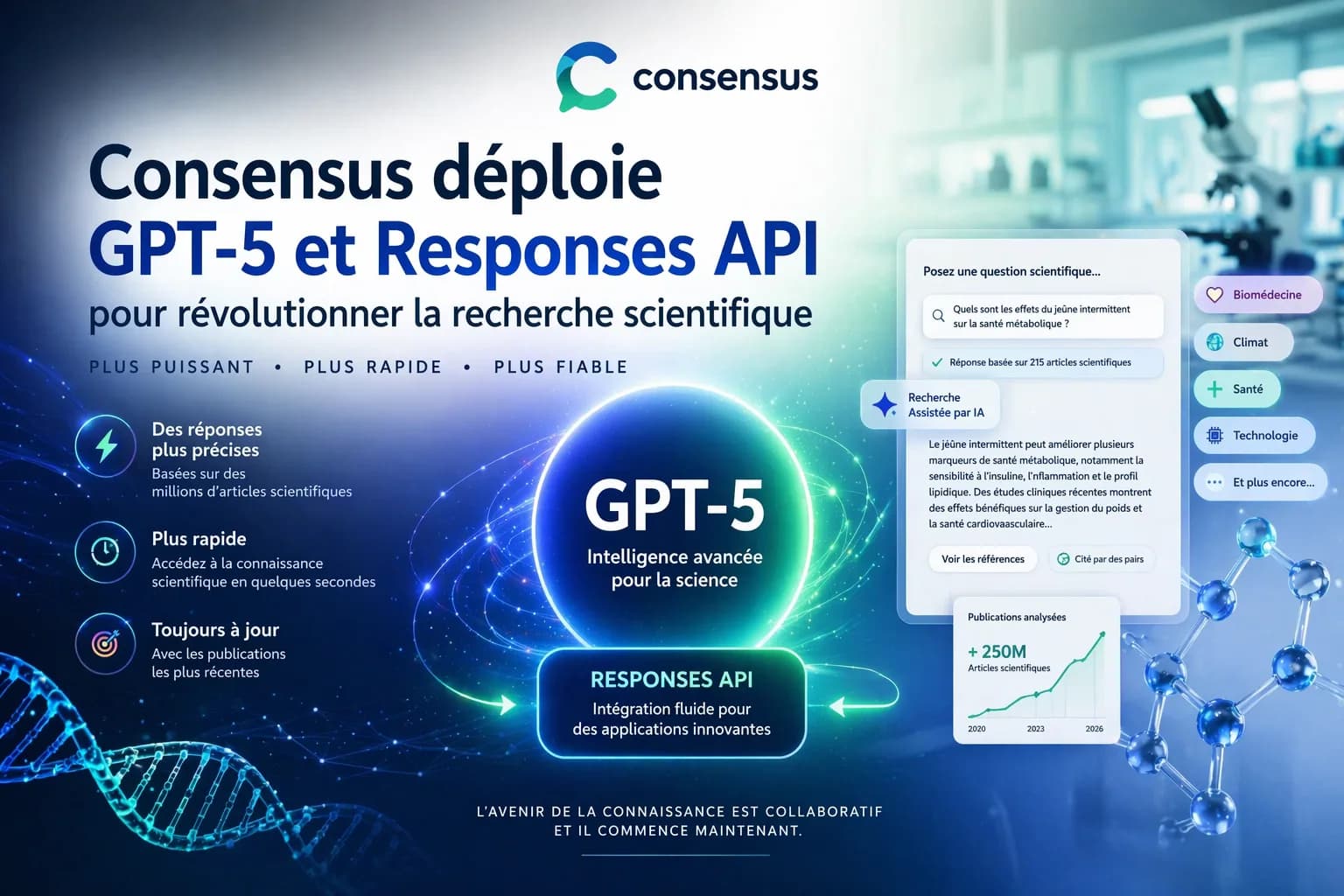
Consensus Deploys GPT-5 and Responses API to Revolutionize Scientific Research
Thanks to the integration of GPT-5 and OpenAI's Responses API, Consensus offers a multi-agent research assistant capable of analyzing and synthesizing scientific data within minutes. Over 8 million researchers are already benefiting from this tool to accelerate their discoveries.
In a constantly evolving scientific landscape, the growing volume of publications and data makes literature research increasingly complex and time-consuming. Researchers must sift through thousands of articles to extract relevant and reliable information, a process that often slows down innovation. To address this challenge, artificial intelligence is emerging as a major lever.
OpenAI, a leading player in the development of advanced AI technologies, has recently released its latest generation model, GPT-5. This model stands out for its enhanced capabilities in understanding, analyzing, and synthesizing text. It offers unprecedented potential to automate and accelerate scientific research processes.
At the heart of this dynamic, Consensus, a platform dedicated to scientific research, has integrated GPT-5 and OpenAI's Responses API to offer a multi-agent assistant. This solution aims to transform how researchers interact with scientific literature and available data by providing quick and reliable summaries.
Facts
Consensus now uses GPT-5 coupled with OpenAI's Responses API to power its research assistant. This system relies on several intelligent agents collaborating to browse, analyze, and synthesize evidence from scientific articles in just minutes. The tool targets a wide audience of researchers, facilitating their systematic review work and data-driven decision-making.
More than 8 million researchers worldwide are already benefiting from this advanced technology. The system notably enables rapid handling of complex questions by extracting relevant conclusions from vast documentary corpora, significantly accelerating the pace of scientific discoveries. This widespread adoption demonstrates the tangible impact of AI in research.
The combination of GPT-5 and the Responses API offers deep analytical capabilities and smooth interaction with data. These tools automate the identification of solid evidence and the synthesis of information, thus reducing possible biases and increasing the reliability of obtained results. This technological improvement opens new perspectives in scientific methodology.
The integration of GPT-5, the latest version of the language model developed by OpenAI, represents a significant qualitative leap. Its fine understanding of natural language and ability to contextualize information allow for more precise analysis of scientific documents. This results in more coherent and relevant summaries, facilitating researchers' decision-making.
Moreover, the Responses API plays a crucial role in orchestrating collaboration between multiple intelligent agents. These specialized agents can query different databases, cross-check results, and produce a reasoned consensus on the questions posed. This multi-agent approach reflects a major advance in leveraging AI for scientific research.
Building on this architecture, Consensus offers an intuitive interface that simplifies access to reliable summaries in just a few clicks. Researchers thus save valuable time that can be reinvested in experimentation and innovation. This innovation changes the game in an environment where speed and rigor are essential.
Analysis and Challenges
The adoption of GPT-5 and the Responses API by Consensus illustrates the convergence between artificial intelligence and scientific research. This synergy addresses an urgent need: managing the explosion of knowledge while maintaining the quality and credibility of results. The tool helps overcome human limitations in collecting and analyzing massive data.
A key challenge lies in the reliability of AI-produced summaries. By automating evidence extraction, it is imperative to ensure source transparency and the verifiability of conclusions. Consensus appears to meet this challenge thanks to a multi-agent architecture that cross-references information to minimize biases and errors.
In the long term, this technology could transform research methodologies by promoting a more iterative and collaborative approach. The acceleration of scientific discoveries, already observed, could pave the way for faster innovations in crucial fields such as health, energy, or the environment. Nevertheless, the scientific community will need to regulate the use of these tools to guarantee ethics and rigor.
Reactions and Perspectives
The research community welcomes this technological advance. Many highlight the benefit of an assistant capable of efficiently synthesizing colossal amounts of information, which significantly reduces their documentary workload. However, some experts emphasize the necessity of retaining human validation to interpret results.
On the side of OpenAI and Consensus, the goal is clear: to democratize access to powerful artificial intelligence serving research while ensuring responsible use. Future versions are expected to include additional features to further refine the accuracy and contextualization of proposed summaries.
Finally, this initiative could inspire other industry players to develop similar solutions, thereby strengthening the ecosystem of AI tools dedicated to science. The challenge is to create a virtuous circle where AI amplifies human potential without replacing it, opening the way to a new era of human-machine collaboration.
In Summary
Consensus leverages GPT-5 and OpenAI's Responses API to offer a multi-agent research assistant capable of quickly reading, analyzing, and synthesizing scientific evidence. This innovation facilitates the work of over 8 million researchers worldwide, thus accelerating the pace of discoveries.
This advance illustrates the growing power of artificial intelligence in the scientific field while raising questions about reliability, ethics, and the modalities of integrating these tools into research practices. The future looks promising for enhanced collaboration between researchers and AI.